China Commissiones Its Third Aircraft Carrier, the Fujian
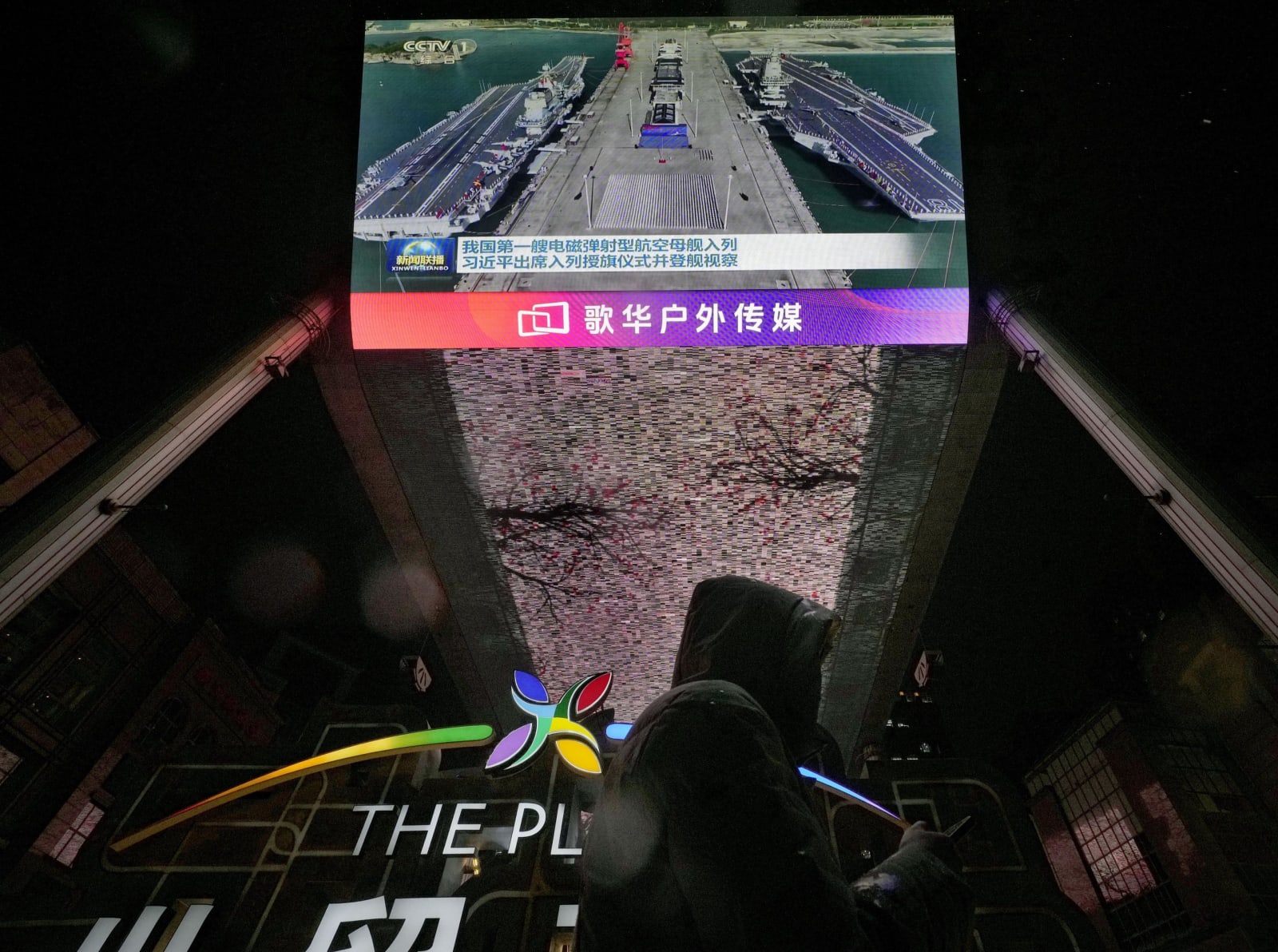
Beijing has officially commissioned its third aircraft carrier, the Fujian, in the southern island province of Hainan. The event was reported by a state news agency, highlighting the significance of this development for China’s naval capabilities.
President Xi Jinping attended a ceremony on Wednesday at a naval port in Sanya to mark the Fujian’s entry into service. This marks a major milestone as the Fujian is not only China’s largest aircraft carrier but also the first to be equipped with an advanced electromagnetic catapult system. This technology allows for faster takeoff of fighter jets, significantly enhancing operational efficiency.
The addition of the Fujian ensures that one of the three carriers can always be deployed for operations, while the other two undergo training or maintenance on a rotating basis. This strategic approach ensures continuous readiness and capability for maritime operations.
Strategic Implications and Capabilities
The over 80,000-ton vessel is part of Beijing’s broader ambition to build a military force capable of deterring U.S. military intervention should China attempt to seize Taiwan, which it claims as part of its territory. The Fujian can operate as part of a two-carrier fleet with China’s other vessels, such as the Liaoning or the Shandong, thereby enhancing the navy’s offshore patrol and defense capabilities.
Construction of the third carrier reportedly began in 2016, with its launch in June 2022. It is said to be capable of carrying between 60 to 70 aircraft, making it a formidable asset in the region.
After the ceremony, which was attended by approximately 2,000 navy personnel and other representatives, Xi inspected the Fujian. On its flight deck, three catapult launch positions were displayed, with carrier-based warplanes—including the J-35 stealth fighter, J-15T heavy fighter jet, and KJ-600 early warning and control aircraft—parked in sequence.
Technological Advancements and International Reactions
The Fujian is the second aircraft carrier in the world to feature an electromagnetic catapult system, following the U.S. Navy’s Gerald R. Ford. President Xi personally decided to adopt this technology for the vessel, which is named after Fujian Province on China’s southeast coast, facing Taiwan.
Taiwan’s Defense Ministry expressed concerns, stating that the Fujian still needs to undergo various training and certification processes before reaching full combat capability. They added that they can effectively monitor and respond to the carrier’s activities by gathering intelligence.
In Tokyo, Chief Cabinet Secretary Minoru Kihara mentioned that Japan will “closely monitor” Chinese military activities, including those of the Fujian, near the country and “calmly and resolutely” respond to them. He emphasized that the Chinese military aims to enhance its operational capabilities in distant seas and airspace with the introduction of the new carrier. “We will take all possible measures to ensure vigilance and surveillance” in areas near Japan, he added.
Future Developments and Regional Dynamics
Hong Kong media reported last year that the construction of China’s fourth aircraft carrier, which could be nuclear-powered, appears to have begun in the northeastern port city of Dalian. This suggests that China is actively expanding its naval capabilities beyond the current three carriers.
The U.S. Naval Institute, a nonprofit military association, warned in 2020 that the Chinese People’s Liberation Army Navy could possess up to six carriers by 2035. This projection underscores the growing strategic importance of China’s naval expansion.
China’s first aircraft carrier, the Liaoning, is a refurbished Soviet-made vessel purchased from Ukraine in the late 1990s that was commissioned in 2012. The second carrier, the Shandong, officially started service in 2019. Both of them feature a “ski-jump” takeoff ramp. In June of this year, the Liaoning and the Shandong were seen operating simultaneously in the Pacific for the first time.
In September, the Fujian traveled to the South China Sea via the Taiwan Strait as part of its multiple sea trials, according to the Chinese navy. This movement highlights the carrier’s increasing role in regional operations and strategic presence.
Leave a Reply
You must be logged in to post a comment.