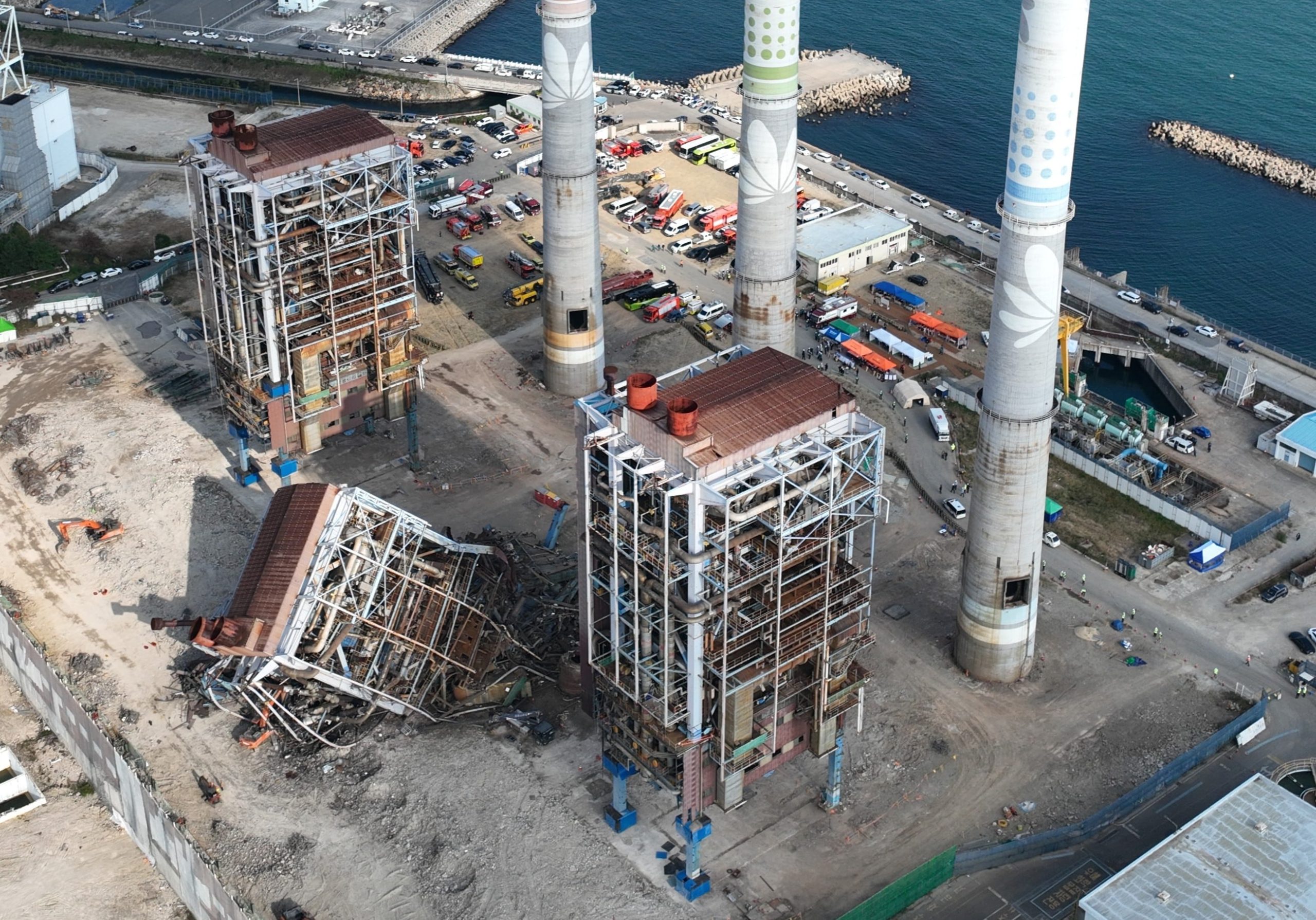
Safety Management Plan Reveals Critical Flaws in Dismantling Process
On the 6th, an analysis of the ‘Safety Management Plan’ prepared by HJ Shipbuilding & Construction Co., the primary contractor involved in the dismantling of a boiler building at the Ulsan Thermal Power Plant, revealed significant discrepancies between the stated procedure and the actual implementation. The plan initially outlined that the structure should be dismantled “from the top down,” but the execution reportedly began from the bottom. This deviation has raised concerns among experts about the sequence of operations leading to the accident.
Experts emphasized that in blasting dismantling, protective measures on upper sections must be completed before weakening lower structures. However, according to the plan documents, the lower sections were removed first. This inconsistency has prompted calls for a thorough investigation into whether the incorrect work sequence contributed to the incident.
Risk Assessments and Countermeasures
According to the ‘Ulsan Thermal Power Plant Units 4, 5, 6 Safety Plan,’ obtained through the office of Democratic Party of Korea Rep. Kim Seong-hoe, the company acknowledged the risk of workers being buried due to structural collapse during dismantling. As a countermeasure, it recommended that dismantling proceed from the upper to the lower sections.
However, the detailed plan for the boiler building dismantling listed “removal of equipment and facilities within 10 meters of the lower boiler” as the first step. In practice, this meant starting the process from the lower section. Prof. Choi Myung-ki of the Korea Industrial Site Professor Group, who analyzed the report, stated, “Generally, structural dismantling should proceed from the top to the bottom.” He added, “Starting from the lower section inherently increases risks.”
Blasting Procedures and Industry Criticisms
The company planned to conduct weakening work after removing the lower section and to carry out protective measures at the final stage, with blasting as the last step. A representative from Koreacaco, the company responsible for the blasting, previously told this newspaper, “At the time of the accident, (the workers) had finished weakening the tower’s lower section and were heading up to perform protective measures,” emphasizing, “We followed the dismantling plan.”
A demolition industry official criticized the approach, stating, “It is a basic principle to complete protective measures before weakening work.” They added, “It is incomprehensible to re-enter a weakened structure for further work.” Prof. Choi also pointed out, “While not explicitly regulated by law, conducting protective work on a structure with a weakened lower section poses safety issues.”
Inconsistent Measurements and Potential Hazards
The plan contained numerous basic errors, including inconsistent measurements. The ‘Project Overview’ section described the boiler building involved in the accident as “12 stories, 63.4 meters high,” while the ‘Key Management Measures’ section listed its height as “56 meters.” The ‘Major Structural Dismantling Plan’ also stated 56 meters. Prof. Choi warned, “In the field, even a 10 cm or 1 meter error can lead to major accidents.”
These inconsistencies highlight a lack of precision and attention to detail, which could have serious implications for the safety of workers and the success of the dismantling project. The discrepancies in the plan suggest that there may have been lapses in communication and coordination between different teams involved in the project.
Conclusion
The findings from the analysis of the Safety Management Plan underscore the importance of adhering to established procedures and maintaining accurate documentation throughout the dismantling process. The reported deviations from standard practices raise serious questions about the safety protocols and the overall management of the project. As the investigation continues, it is crucial that all stakeholders take these lessons into account to prevent similar incidents in the future.
Leave a Reply
You must be logged in to post a comment.