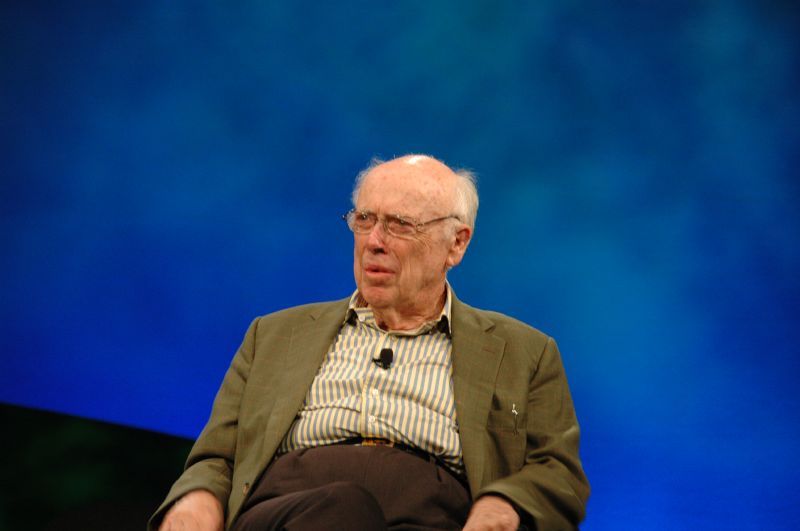
The Life and Legacy of James Watson
James Watson, a pioneering American scientist and co-discoverer of the DNA structure, passed away at the age of 97. His groundbreaking work with Francis Crick in 1953 unveiled the double-helix structure of DNA, a discovery that revolutionized the fields of biology and medicine. Their research illuminated how genetic information is stored and transmitted, earning them and Maurice Wilkins the 1962 Nobel Prize in Physiology or Medicine.
At the time of their discovery, Watson and Crick famously declared, “We have discovered the secret of life.” This statement marked a turning point in scientific history, laying the foundation for modern genetics and molecular biology.
Watson spent much of his career at the Cold Spring Harbor Laboratory (CSHL) in New York, where he led the institution for several decades. However, his legacy was marred by controversy following remarks he made about race and intelligence. In a 2007 interview withThe Times, he suggested that there were genetic differences in intelligence between races, stating, “I am inherently gloomy about the prospect of Africa,” and adding that “all our social policies are based on the fact that their intelligence is the same as ours whereas all the testing says not really.”
These comments sparked widespread condemnation, leading to his resignation as chancellor of CSHL. He later issued an unreserved apology, but the damage to his reputation was significant. In 2019, further remarks linking race and intelligence prompted the laboratory to strip him of his remaining honorary titles. A statement from CSHL described his statements as “reprehensible, unsupported by science.”
The Discovery of DNA and Its Controversies
DNA was first discovered in 1869, but its role as the genetic material in cells wasn’t confirmed until 1943. The molecule’s structure remained a mystery until Watson and Crick built their model using X-ray images produced by Rosalind Franklin at King’s College London. These images were reportedly obtained without her consent, a fact that has been widely criticized in recent years.
Although Franklin died in 1958, she is now widely recognized for her crucial contributions to solving the DNA structure. At the time, however, her work was largely overlooked. Watson also faced criticism for sexist remarks in his 1968 memoir,The Double Helix, where he commented on Franklin’s appearance. Despite this, some former colleagues noted that he supported women scientists at Harvard in the 1950s and 60s, when few others did.
Personal Life and Later Years
Watson was born in Chicago in April 1928, the son of Jean and James Watson, descendants of English, Scottish, and Irish settlers. A gifted student, he entered the University of Chicago at 15, where he became interested in X-ray diffraction, a key technique in revealing atomic structures.
He later studied at Cambridge University, where he met Crick and began building models of DNA. After their discovery, he joined Harvard University as a biology professor. Watson and his wife, Elizabeth, had two sons. One was diagnosed with schizophrenia, which inspired Watson to continue research into the genetic basis of mental illness.
In 1968, he became director of Cold Spring Harbor Laboratory, transforming it into a leading global center for molecular biology research. It was the same institution that later confirmed his death.
Financial and Personal Struggles
In 2014, feeling isolated from the scientific community, Watson sold his Nobel medal for $4.8 million. The Russian buyer later returned it to him. This event highlighted the personal challenges he faced in the latter years of his life.
Watson’s life and work remain a complex mix of scientific achievement and personal controversy. His contributions to genetics and molecular biology have left an indelible mark on the field, while his controversial statements have cast a long shadow over his legacy.
Leave a Reply
You must be logged in to post a comment.